1-6 September 2025
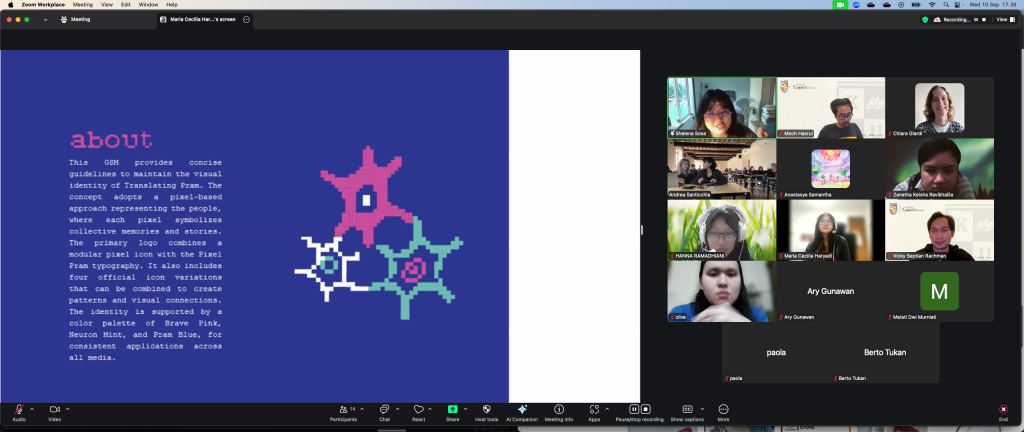
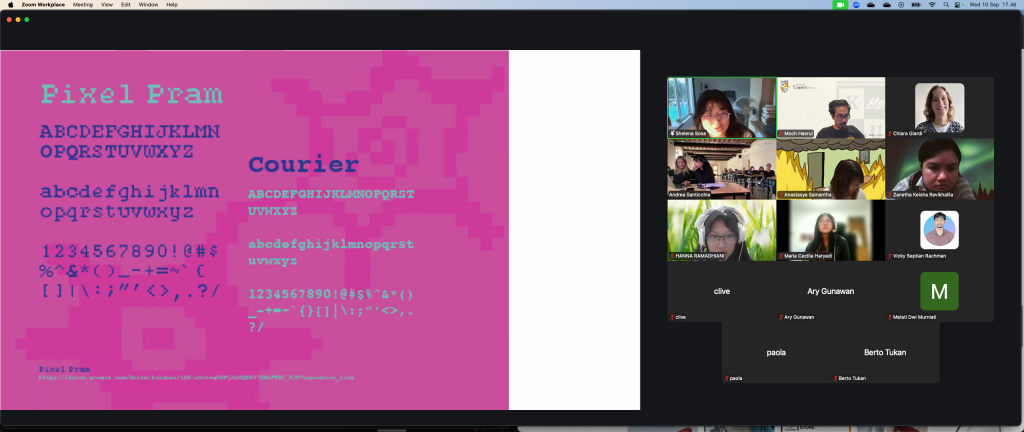
This workshop is a collaboration between Kalbis University (Jakarta) and the University of the Republic of San Marino (UNIRSM). Around 30 undergraduate and master’s design students took part in a hybrid format. Kalbis students formulated the visual identity for the Translating Pram exhibition—including the key visual and identity guidelines—and compiled and developed citizen-based historiography grounded in the works of Pramoedya Ananta Toer. UNIRSM students articulated the key visual and the corpus of citizen historiography into an interactive work, facilitated by Andrea Santicchia.
The Jakarta workshop was initially scheduled in person for 1–6 September 2025. In response to the socio-political situation and the escalation of demonstrations in late August 2025 in Jakarta—triggered by repressive actions by security forces in handling the protests—Kalbis University shifted to an online format to ensure everyone’s safety.
The workshop opened with a public lecture, “Integrating Pramoedya Ananta Toer and Citizen-Based Indonesian Historiography,” by Martin Suryajaya. The talk mapped historical practice beyond the Great Man Theory and illustrated citizen historiography through the film The Act of Killing as a grassroots voice; the aim was not to replace official narratives, but to add perspectives, expose gaps, and test truth claims through citizens’ stories, archives, and memories. Martin outlined two working domains: the upstream domain—gathering materials from clippings, archives, interviews, conversations, and cross-verification—and the downstream domain—shaping them into narrative through point-of-view choices, sequencing events, character development, and articulation in literary form. This framework was applied in the workshop: the timeline group worked upstream by organizing sources and family stories, while the visual group worked downstream by transforming findings into a visual identity and argumentative artifacts. Each output included source notes, rationales for visual choices, and ethical boundaries of representation.
The workshop continued with an ideation session responding to Martin’s lecture. Participants—Rasyid Anwar, Shelena Sosa, Maria Cecilia, Anastasya Samantha, Zanetha Keisha, Hanna Zuhra, and Clive Jo—from the Visual Communication Design program at Kalbis University translated Pramoedya’s ideas into visual form. Students split into two teams: a visual team tasked with formulating the key visual, and a timeline team tasked with mapping a core timeline of Pramoedya’s works and collecting citizen-based historiography at the smallest context of their own families. Students chose groups independently according to their interests and competencies.
With a collaborative and participatory format, the visual team developed concepts based on their readings and experience of Pramoedya’s works. Keywords included: typewriter, time, rhizome, pixel, neuron, and network. The base key visual was proposed by Shelena Sosa, developed with Rasyid Anwar, with illustrative contributions from Zanetha Keisha. Initial outputs included the Pixel Pram typeface, two primary visual elements, and a color palette.
The color palette refers to markers of civic protest that peaked in August 2025 as public anger accumulated over the planned increase in housing allowances for members of parliament amid economic pressures (inflation, low wages, rising taxes)—coinciding with the workshop schedule. It emerged from how citizens read and responded to demonstrations in Jakarta. Pink is drawn from the figure of Ibu Ana in a pink headscarf, recorded confronting police while swinging a bamboo stick tied with the Indonesian flag. Resistance Blue refers to the “Indonesia Emergency Warning” call that circulated in late August 2024. Hero Green refers to the color of the jacket and helmet of the ride-hailing driver who was killed after being run over by a police tactical vehicle during the protest. In this workshop, the palette was adjusted for accessibility, including legibility for users with partial color-vision deficiency.
In the timeline group, Anastasya Samantha, Zanetha Keisha, Maria Cecilia, and Hanna Zuhra compiled data on Pramoedya Ananta Toer. They set five time markers as the basis of the timeline and added family stories linked to those markers. Point 1 summarizes Indonesian history in Pram’s works: the colonial period, post-independence, the 1965 events, the New Order, and the trajectory from banned books to the curriculum. Point 2 compiles factual events and citizen historiography on 1965. Point 3 highlights interpretation and transmediation of Pramoedya’s works. Point 4 maps the international impact of Pramoedya’s works. Point 5 records current conditions in Indonesia and a call to document and archive.
Coordination of both groups was led by Maria Cecilia, who managed workflows and communication throughout the workshop. The Jakarta session concluded with presentations of process and results to UNIRSM students as a relay to be continued and articulated into an interactive work.
Moch Hasrul