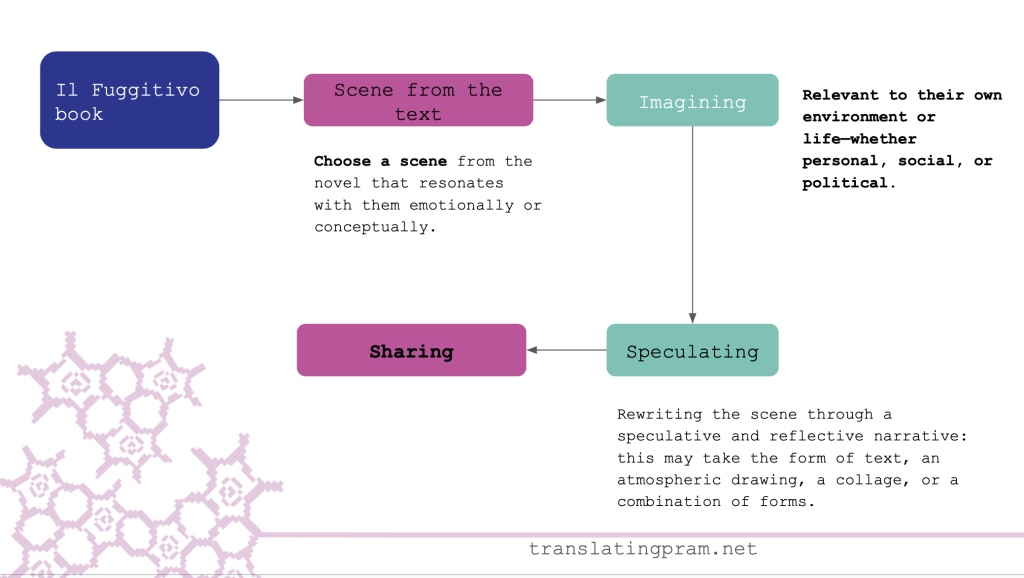
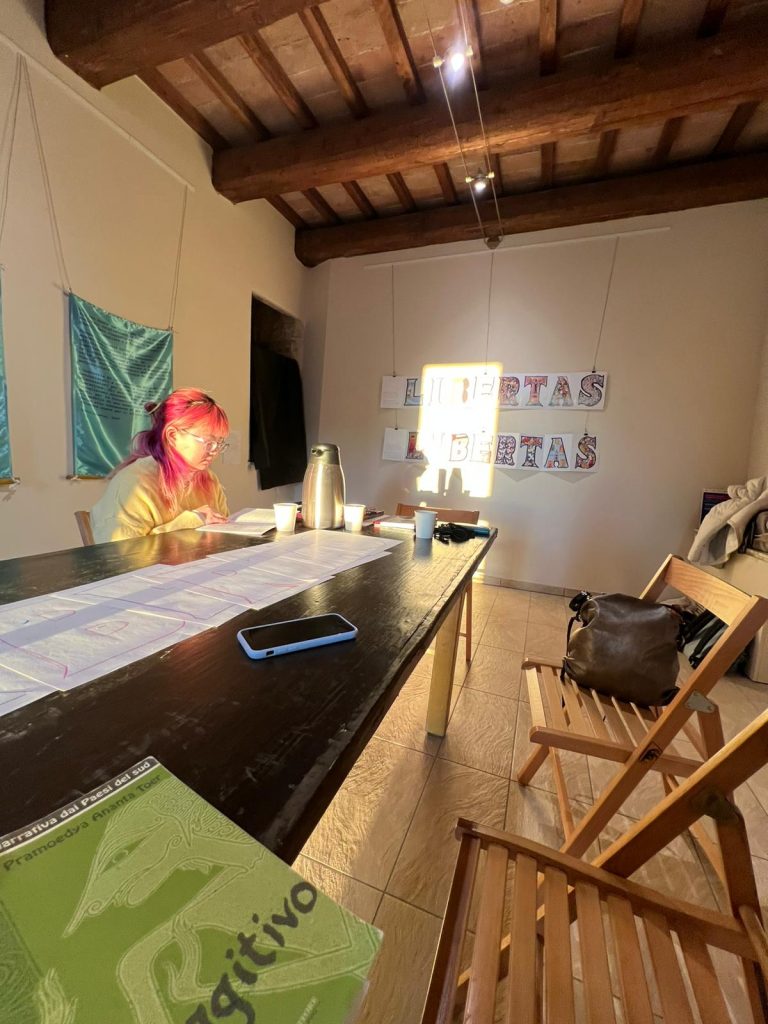
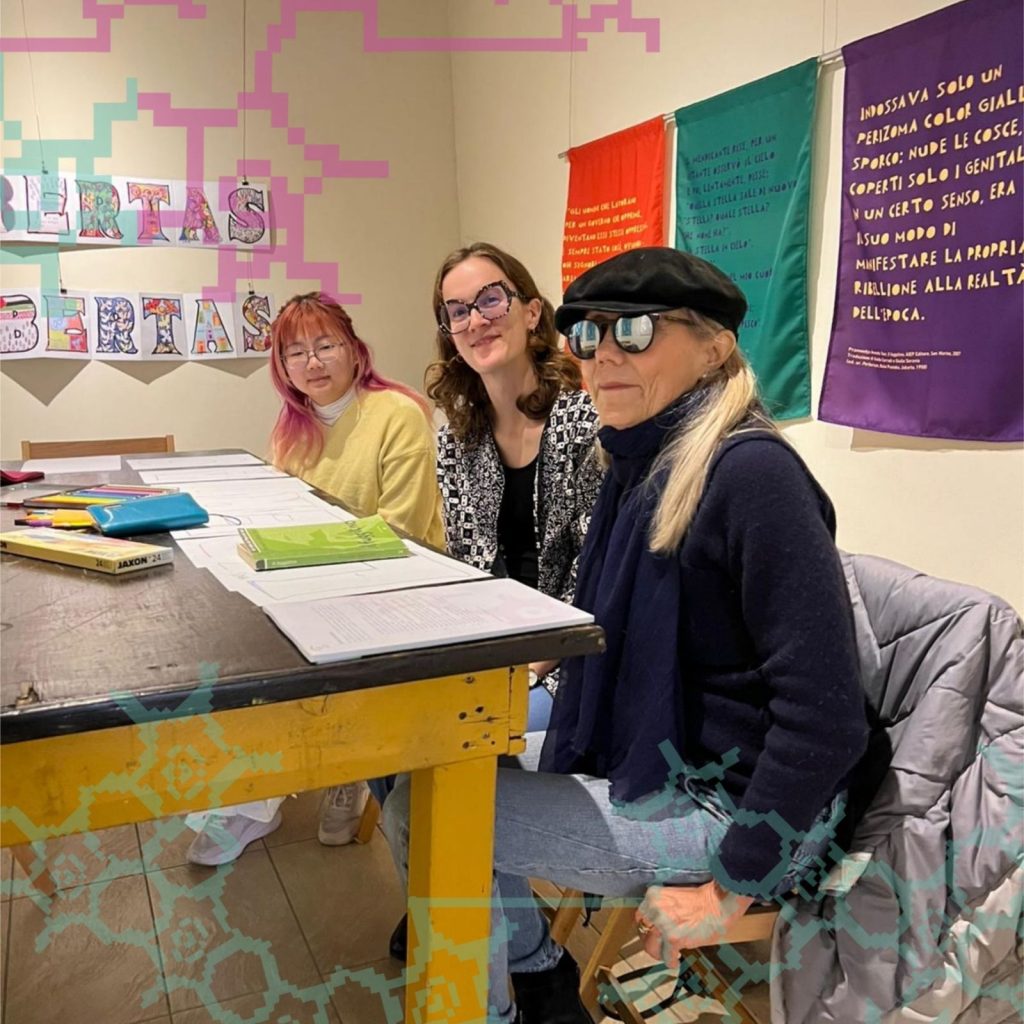
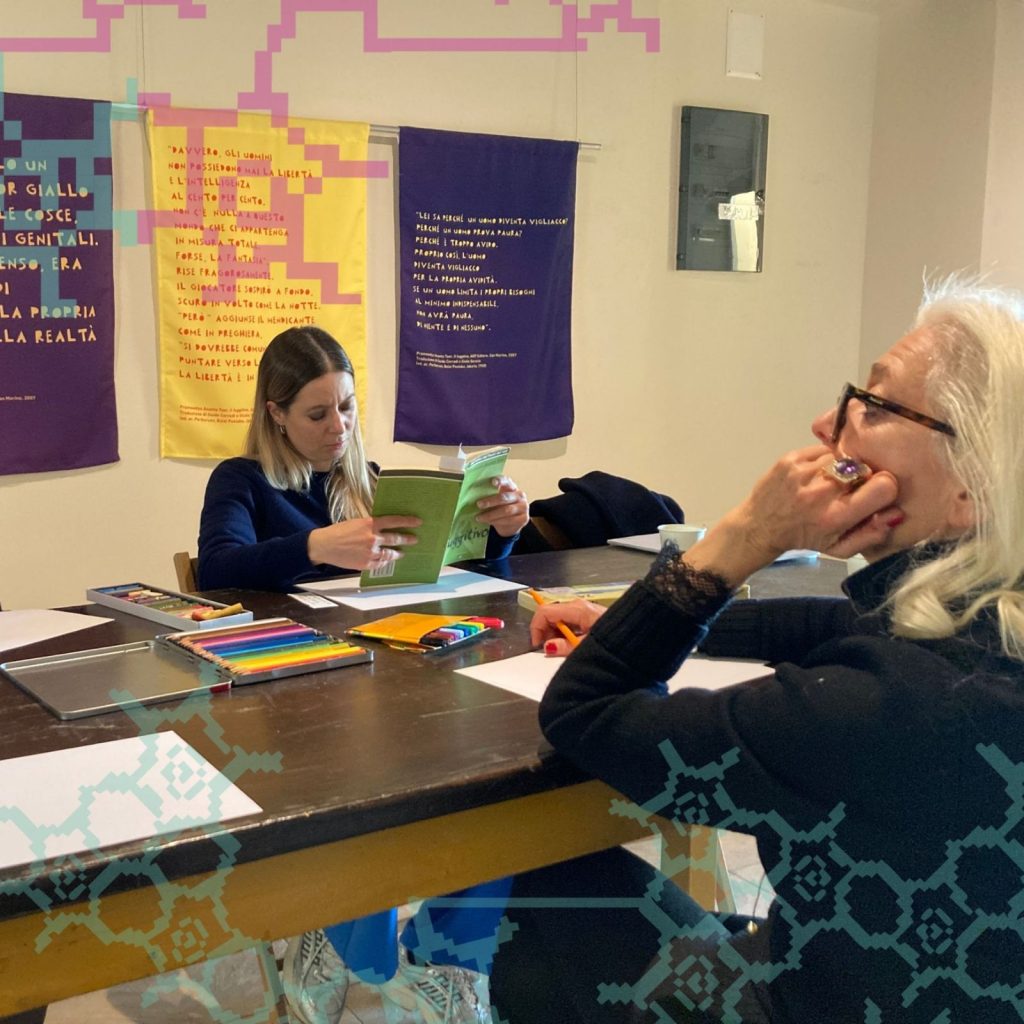
This workshop invites participants to reimagine selected scenes from Il Fugitivo by Pramoedya Ananta Toer through the lens of their own lives and environments. After choosing a scene that resonates emotionally or conceptually, participants imagine how it might unfold in their personal, social, or political context—past, present, or future.
They then rewrite the scene as a speculative and reflective narrative, using text, drawing, collage, or a combination of forms. The resulting works don’t aim for historical accuracy, but rather explore new meanings through personal interpretation.
By doing so, participants engage in a form of citizen-based historiography—where history is shaped not by grand narratives, but by everyday imagination.
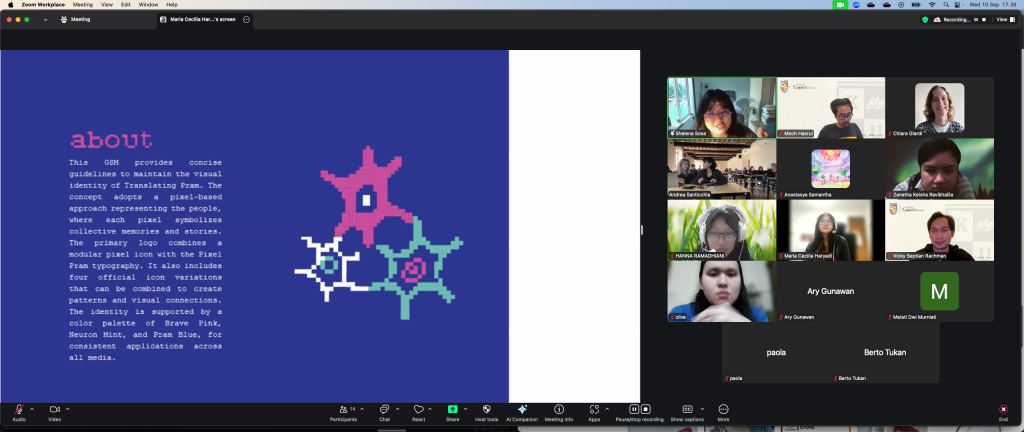
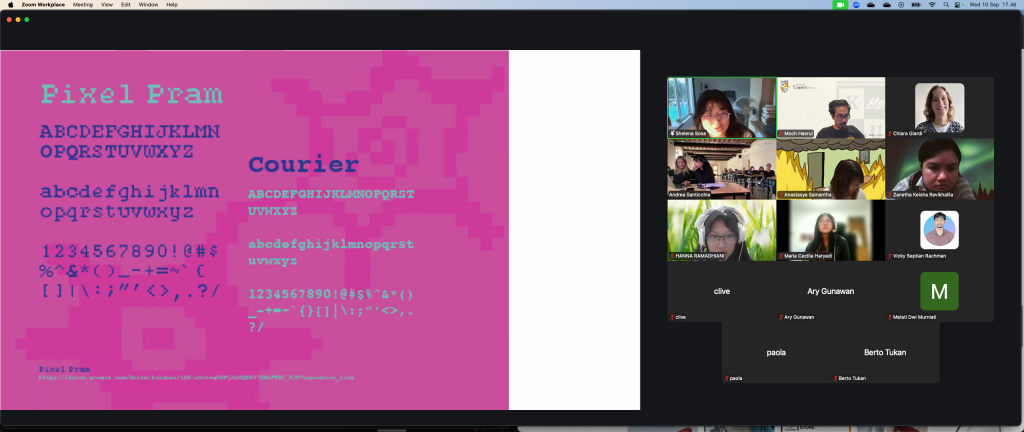
This workshop is a collaboration between Kalbis University (Jakarta) and the University of the Republic of San Marino (UNIRSM). Around 30 undergraduate and master’s design students took part in a hybrid format. Kalbis students formulated the visual identity for the Translating Pram exhibition—including the key visual and identity guidelines—and compiled and developed citizen-based historiography grounded in the works of Pramoedya Ananta Toer. UNIRSM students articulated the key visual and the corpus of citizen historiography into an interactive work, facilitated by Andrea Santicchia.
The Jakarta workshop was initially scheduled in person for 1–6 September 2025. In response to the socio-political situation and the escalation of demonstrations in late August 2025 in Jakarta—triggered by repressive actions by security forces in handling the protests—Kalbis University shifted to an online format to ensure everyone’s safety.
The workshop opened with a public lecture, “Integrating Pramoedya Ananta Toer and Citizen-Based Indonesian Historiography,” by Martin Suryajaya. The talk mapped historical practice beyond the Great Man Theory and illustrated citizen historiography through the film The Act of Killing as a grassroots voice; the aim was not to replace official narratives, but to add perspectives, expose gaps, and test truth claims through citizens’ stories, archives, and memories. Martin outlined two working domains: the upstream domain—gathering materials from clippings, archives, interviews, conversations, and cross-verification—and the downstream domain—shaping them into narrative through point-of-view choices, sequencing events, character development, and articulation in literary form. This framework was applied in the workshop: the timeline group worked upstream by organizing sources and family stories, while the visual group worked downstream by transforming findings into a visual identity and argumentative artifacts. Each output included source notes, rationales for visual choices, and ethical boundaries of representation.
The workshop continued with an ideation session responding to Martin’s lecture. Participants—Rasyid Anwar, Shelena Sosa, Maria Cecilia, Anastasya Samantha, Zanetha Keisha, Hanna Zuhra, and Clive Jo—from the Visual Communication Design program at Kalbis University translated Pramoedya’s ideas into visual form. Students split into two teams: a visual team tasked with formulating the key visual, and a timeline team tasked with mapping a core timeline of Pramoedya’s works and collecting citizen-based historiography at the smallest context of their own families. Students chose groups independently according to their interests and competencies.
With a collaborative and participatory format, the visual team developed concepts based on their readings and experience of Pramoedya’s works. Keywords included: typewriter, time, rhizome, pixel, neuron, and network. The base key visual was proposed by Shelena Sosa, developed with Rasyid Anwar, with illustrative contributions from Zanetha Keisha. Initial outputs included the Pixel Pram typeface, two primary visual elements, and a color palette.
The color palette refers to markers of civic protest that peaked in August 2025 as public anger accumulated over the planned increase in housing allowances for members of parliament amid economic pressures (inflation, low wages, rising taxes)—coinciding with the workshop schedule. It emerged from how citizens read and responded to demonstrations in Jakarta. Pink is drawn from the figure of Ibu Ana in a pink headscarf, recorded confronting police while swinging a bamboo stick tied with the Indonesian flag. Resistance Blue refers to the “Indonesia Emergency Warning” call that circulated in late August 2024. Hero Green refers to the color of the jacket and helmet of the ride-hailing driver who was killed after being run over by a police tactical vehicle during the protest. In this workshop, the palette was adjusted for accessibility, including legibility for users with partial color-vision deficiency.
In the timeline group, Anastasya Samantha, Zanetha Keisha, Maria Cecilia, and Hanna Zuhra compiled data on Pramoedya Ananta Toer. They set five time markers as the basis of the timeline and added family stories linked to those markers. Point 1 summarizes Indonesian history in Pram’s works: the colonial period, post-independence, the 1965 events, the New Order, and the trajectory from banned books to the curriculum. Point 2 compiles factual events and citizen historiography on 1965. Point 3 highlights interpretation and transmediation of Pramoedya’s works. Point 4 maps the international impact of Pramoedya’s works. Point 5 records current conditions in Indonesia and a call to document and archive.
Coordination of both groups was led by Maria Cecilia, who managed workflows and communication throughout the workshop. The Jakarta session concluded with presentations of process and results to UNIRSM students as a relay to be continued and articulated into an interactive work.
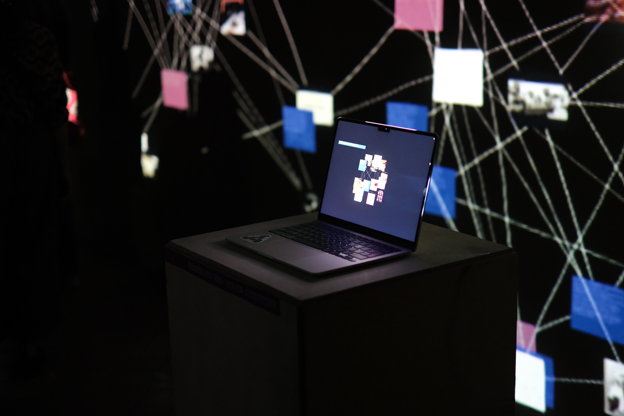
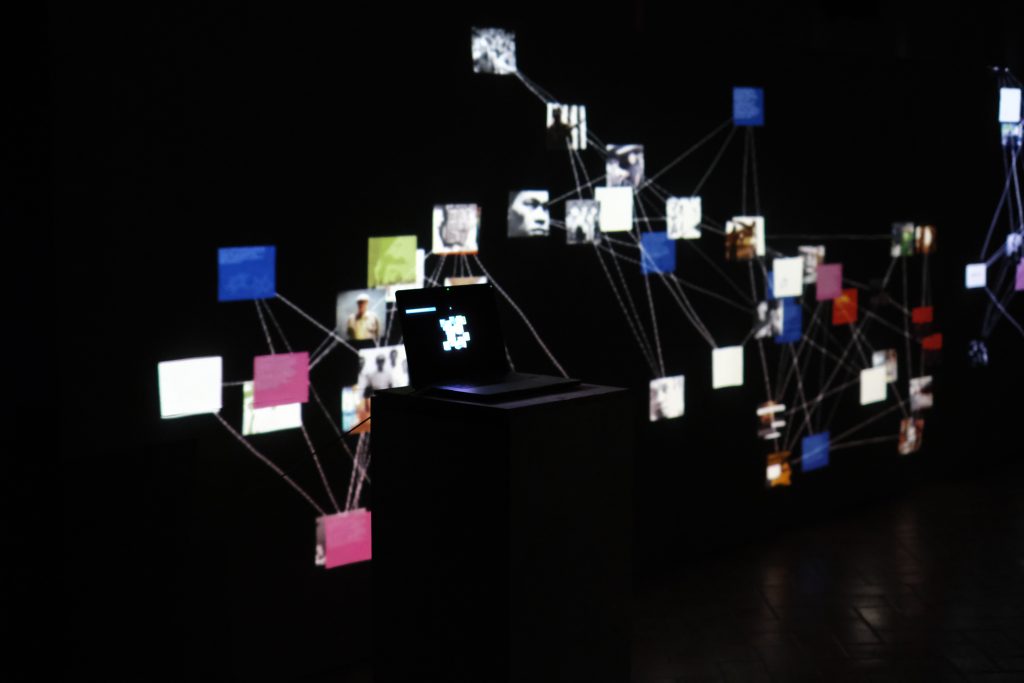
Translating Pram: Interactive Timelines is a joint workshop developed by the University of the Republic of San Marino and Kalbis University in Jakarta, Indonesia. Its objective is to design an immersive interactive installation built around a digital timeline that narrates the key events in the life and literary production of Indonesian writer and activist Pramoedya Ananta Toer, contextualizing them within the broader historical evolution of Indonesia.
The collaboration began with preliminary work carried out by the Indonesian partners, who developed the visual identity and selected the materials forming the foundation of the timeline content. The workshop in San Marino opened with a presentation of The Fugitive, one of Pramoedya’s works published in Italian by AIEP Editore. This session offered a historical, literary, and political introduction that guided the subsequent design phases and framed the author’s autobiographical and memory-based narrative approach.
The first day focused on mutual introductions: through short presentations, students shared their interests, skills and goals, enabling the formation of interdisciplinary groups that combined expertise in graphic design, interaction design, spatial design, and programming. The teams were assigned distinct yet interconnected domains: programming (developing TouchDesigner patches and interaction algorithms), exhibition design (layout, materials, and spatial prototyping), graphic design (content organization and production of visual materials) and interaction research (public engagement strategies and experiential mood definition).
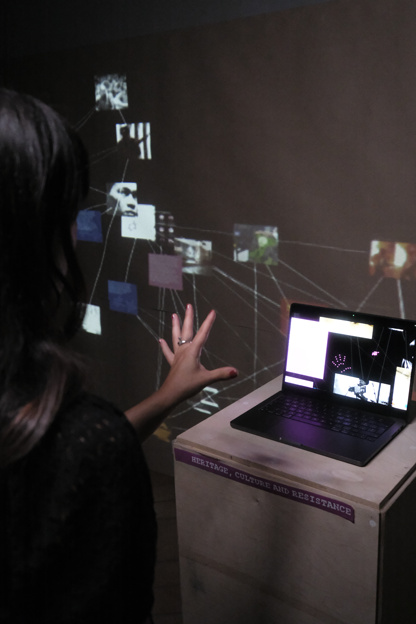
During the second day, a videoconference allowed the Indonesian students to present their preliminary contributions and symbolically hand over the project to the San Marino team. This was followed by a hands-on TouchDesigner session exploring AI-based tracking of hands, gestures and body movements applied to visual and sound interactions.
As the workshop progressed, the groups integrated visual, spatial, and interactive elements into a unified installation centered on a digital interactive timeline. The resulting environment narrated the key events of Pramoedya’s life and works through a system combining textual materials, animations, thematic viewpoints and micro-interactions. All components were conceived as modular and easily reconfigurable in anticipation of the Translating Pram exhibition scheduled for December 2025 at Palazzo Graziani in San Marino.
The concluding day coincided with the public opening of the University of San Marino’s workshop week (September 2025), during which the installation was tested by about one hundred visitors. This testing phase provided valuable insights into engagement dynamics, supported usability refinements, and validated the effectiveness of translating narrative content into an interactive experience.
The workshop in San Marino was led by designer Andrea Santicchia, with the support of tutor Valentina Ugolini, and involved students from the Bachelor’s Programme in Design and the Master’s Programme in Interaction & Experience Design. Participants included: Asia Arcangeli, Giovanni Conti, Nicolò De Chiara, Daria Ferent, Caterina Fortuzzi, Lucia Grandoni, Kiara Haxhiraj, Matilde Lepri, Anastasia Manenti, Aiperi Myrzabekova, Lucia Morri, Alessia Maria Policala, Alessio Signorotti, Laura Pesenti, Giacomo Zanardi, Filippo Zoja, Miriana Briscese, and Dante Bellucci.
The results were later presented to students and faculty at Kalbis University, further strengthening the academic and design-oriented collaboration between the two institutions and contributing to the broader Translating Pram initiative.
Apertura con saluti istituzionali e presentazione del workshop internazionale interuniversitario presso la Sala Conferenze.
A seguire, lectio di Antonia Soriente, Professoressa ordinaria di Lingua e letteratura indonesiana all’Università di Napoli L’Orientale, esperta di letteratura indonesiana e traduttrice da e per l’indonesiano.
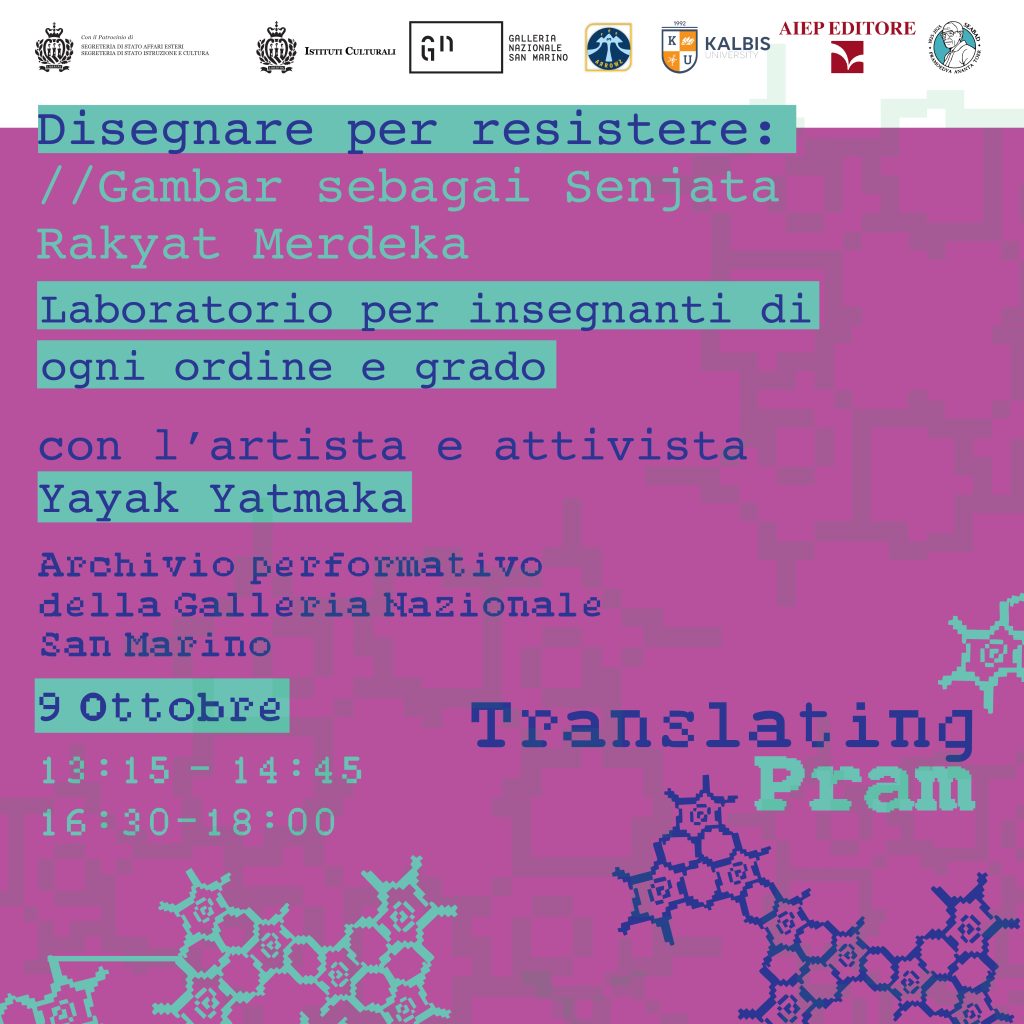
Laboratorio per insegnanti di ogni ordine e grado con Yayak Yatmaka
🗓️ 9 ottobre 🕐 13:15–14:45 e 16:30–18:00 📍Archivio Performativo – Galleria Nazionale
Yayak Yatmaka è un artista e graphic designer indonesiano, noto per il suo impegno politico attraverso l’arte visiva. Nato nel 1956, ha studiato design grafico all’Istituto Tecnologico di Bandung. Negli anni ’80 ha fondato l’ONG SAMIn, dedicata all’educazione alternativa per i bambini, e ha realizzato fumetti e materiali didattici contro lo sfruttamento minorile, utilizzati in scuole di diversi paesi. A causa delle sue opere critiche verso il regime di Suharto, nel 1992 è stato costretto all’esilio in Germania, dove ha continuato la sua attività artistica e militante, co-fondando la Rete di Opposizione per la Democrazia Indonesiana in Europa. Le sue opere affrontano temi come i diritti umani, la giustizia sociale, la resistenza politica e le questioni ambientali, e sono state esposte in Europa e Indonesia dal 1991 a oggi. Ha anche pubblicato diversi libri, tra cui “Il militarismo per principianti” e “Il movimento della sinistra indonesiana per principianti”.
Siete caldamente invitatə a partecipare e vi chiediamo, se possibile, di diffondere l’invito.